
Wouldn’t it be great if your marketing and sales could run on autopilot?
Well with an automated sales funnel, they can! After an initial set-up, you can sit back, relax, and focus your attention on other marketing tasks.
An automated marketing and sales funnel allows you to work smarter, not harder. It can skyrocket your efficiency and effectiveness. If you aren’t using one already, it’s about time you hop aboard this train to growth!
The Sales Funnel
 You’ve probably heard this phrase before. Many, many, many times I imagine. Let’s quickly debrief anyway.
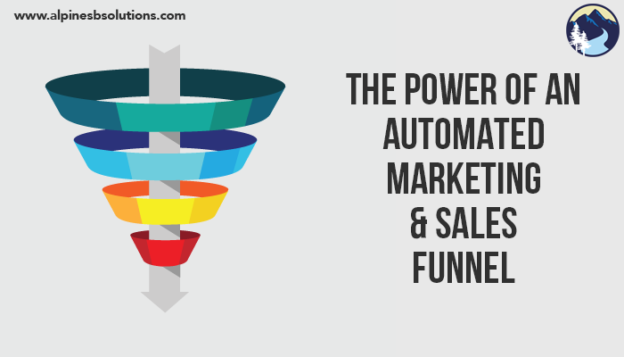
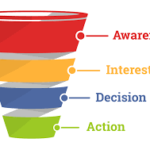
A sales funnel is the journey people go through from first discovering your company to paying money for your goods/services. The stages go:
- People become aware of your brand
- People become interested in your brand
- People have desire for what your brand offers
- People take action (buying a product/service)
Not everyone makes it through every stage. That is why it’s a funnel – it’s largest at the top and becomes narrower as it goes down. As a marketer, your goal is to move as many people as possible through the funnel.
Automating the Funnel
 Automation, when done well, can be a marketer’s best friend. First of all, it saves you an immense amount of time. Instead of you sitting down to individually send an email to people at each stage of the funnel, these emails can be sent automatically.
Second of all, it can improve your targeting efforts without any extra efforts on your end. For example, someone who opts-in to your social media newsletter gets a follow-up email offering them a discount for your social media services. Someone who opts-in to your business management newsletter gets a follow-up email offering them a discount for your upcoming leadership webinar. These targeted pitches can happen automatically.
How to Create Your Automated Email Funnel
The most common way to automate your marketing and sales funnel is with your email.
- Creating awareness: Here you are hoping to stir up awareness of your brand. Many marketers will offer a free downloadable piece of content in exchange for someone’s email. Think case studies, guides, and other similar substantial pieces of content. The focus here is to get your company name in their memory and associate yourself within the industry. Nothing sales-y at all, yet!
- Creating interest: Now you’ve gotten their email. Here you are hoping to keep their
 attention (since that “unsubscribe button” is all too easy to press). Send a follow-up email to those who subscribed giving them more helpful information. Nothing sales-y here either! The goal is to intrigue your audience about your brand by showing you know your stuff. Send an email with a round-up of useful articles on the given topic. Share valuable resources. Prove that your emails (and your company) offer value.
 - Creating desire: Now you’ve got a group of people who stayed on your email list. By now, you’ve sent a few useful emails. They are still intrigued by your company. Now you can start slipping in the sales-y content. Show off what your brand can do. Maybe it’s an email with testimonials of a product. Maybe it’s case studies of how companies benefited from your service. Draw a connection between your customer’s problem and your product/service as a solution.
- Creating action. Now that you got your customers desiring your product/service, you can prompt action. Send an email that provides a discount for first time customers. Direct them to the sales page. Funnel those potential customers into becoming purchasing customers.
This process can be a highly effective one at generating more leads and more sales. You will need specialized tools to accomplish this (MailChimp is a common one). Look through different service options to find the best ones for your company. The key here is finding something that offers effective automation. You want a service allowing for targeted funnel creation (such as one path for first time customers and another path for repeat customers).
It’ll take some time at first to situate your funnel. But once you do, you can reap the rewards of automation! If you want help setting up your funnel, Alpine Small Business Solutions is here for you! We specialize in sales funnel services that can get your marketing thriving. Contact us today to find out more!
 The “
The “ When you create a social media sales funnel, you supercharge your
  Once you know which channels to be on, you can work on generating that awareness. Facebook ads, for example, can help potential customers discover your page. When applicable, tag other organizations in your posts to help your posts show up on their followers’ pages. Cross promote your social channels through strategies like including the social links in your email signatures or newsletters.

 year. It’ll change as unexpected expenses and outstanding situations arise, but it will help provide the
 Think of your social media as a body. Your goal is a healthy thriving body, which requires two approaches.
 You also need to take a long-term approach, adopting and adapting
  business is chugging along like normal, you can match that approach in
 You can’t find the perfect candidate if you don’t know what the perfect candidate looks like. Start off by figuring out what tasks you need accomplished (hint: you can use our
  Once you’ve got a clear picture of what you need, you can start spreading the word that you’re looking for a new virtual assistant. You’ll need to create a clear job listing that details everything you need (i.e. everything from step one). Include something quirky to make sure the person actually reads your listing and can follow directions (for example, asking candidates to mention their favorite movie in the last paragraph to ensure they aren’t just mass posting an application).
 Ask candidates for a resume, references, and work samples to ensure their experience and work is up to your standard. Conduct an in-person or webcam interview to get a feel for them beyond their application. It’ll allow you to get a glimpse into their work setting, their fluency of English, their personality, their energy, and all the other intangibles that play a role into how they will fit into your organization. Even though they won’t be coming into the office, it’s important to be sure that their

 Twitter is a great tool to direct individuals to your website. In this way you can think of Twitter and your website like a news story. The headline and the lead are the Twitter post: it draws you in and provides just enough information you know what you’ll be reading about. The body of the article is your website post: the substance and entirety of what you want your audience to read. While posts can be great at directing individuals to your site, not every post needs to. Some posts can be a short story or message in of themselves.
  Linkedin is great for increasing brand awareness and acquisition. Individuals can publish articles on
  Marketers post content to help boost their SEO. Oftentimes marketers strapped for time post their Facebook posts on
  Creating engaging videos is a great way to turn out shareable content, engage audiences, and improve SEO.
  Like Twitter,
 you avoid too many keywords (which can make your profile a dry read). You really want to think about what your audience is looking for and write for that. Answer those questions, and use those words. Utilize a few strategies to establish the best keywords for you. First, brainstorm words and phrases likely to be searched by the individuals you want viewing your profile. Second, read through profiles of leaders in your target markets to find common keywords they use. Third, examine keywords used in job postings by your target employers. Integrate these keywords throughout your profile, from your specialties section to your link descriptions.
 7 Tips on How to Use Facebook Live

 Affiliate marketing happens when your marketing efforts bring another organization visitors and/or customers. In return, the other organization provides you with monetary compensation for each visitor/customer. Affiliate marketing can involve providing links on your website to products from other organizations or including ads for other organizations on your website. If your link provides the organization with a sale (someone purchases a product after clicking on your product link), you receive monetary compensation. A great place to start with affiliate marketing is with Amazon Associates. They offer a simply set up (or get your VA to help you set it up) and Amazon has a huge product selection, so you can always find something to tell your viewer they should use.
 Here you want to brainstorm ways to convert your expertise into a practical service to meet your customers’ needs. For example, a travel blogger could offer a trip
  Here the idea is to brainstorm ways to convert your expertise into a tangible product to meet your customers’ needs. You will want to build something that once it is created, it is ready to go and doesn’t take any effort on your part. For example, if you’re a photographer, sell photos through stock photography. If you’re a food blogger, sell e-books that are collections of recipes. Most of the work is with creating the product. Once that’s completed, you’ll just need minimal advertising efforts. You can even just link to the product on your website, and make the occasional promotional social media post, and call it good.
 Take all that industry expertise and knowledge you’ve got, and monetize it! Ask yourself, “What does an individual need to know to become an expert on given topic, tool, etc?” Answer that question with your knowledge in the form of an online training session or webinar. When you first start out, focus on creating “evergreen” content (information people can use over and over at any time). Something that you don’t have to do live or be there for. For example, “How to advertise your organization on
  For some topics, presenting the ideas in person makes more sense than presenting them online. That’s where the idea of a seminar or class comes in. Take the knowledge you’ve got and present it to a
 You can study your audience as a whole, or break up your audience into segments (such as only looking at female followers, or only individuals 18 to 25). To segment the audience, enter in information (such as age bracket) on the left-hand side. How much you want to segment your audience depends on the campaign you’re gathering data for.
 The “
The “